Call (725) 765-9243
A roofing specialist answers and records the address, roof material, and concern.
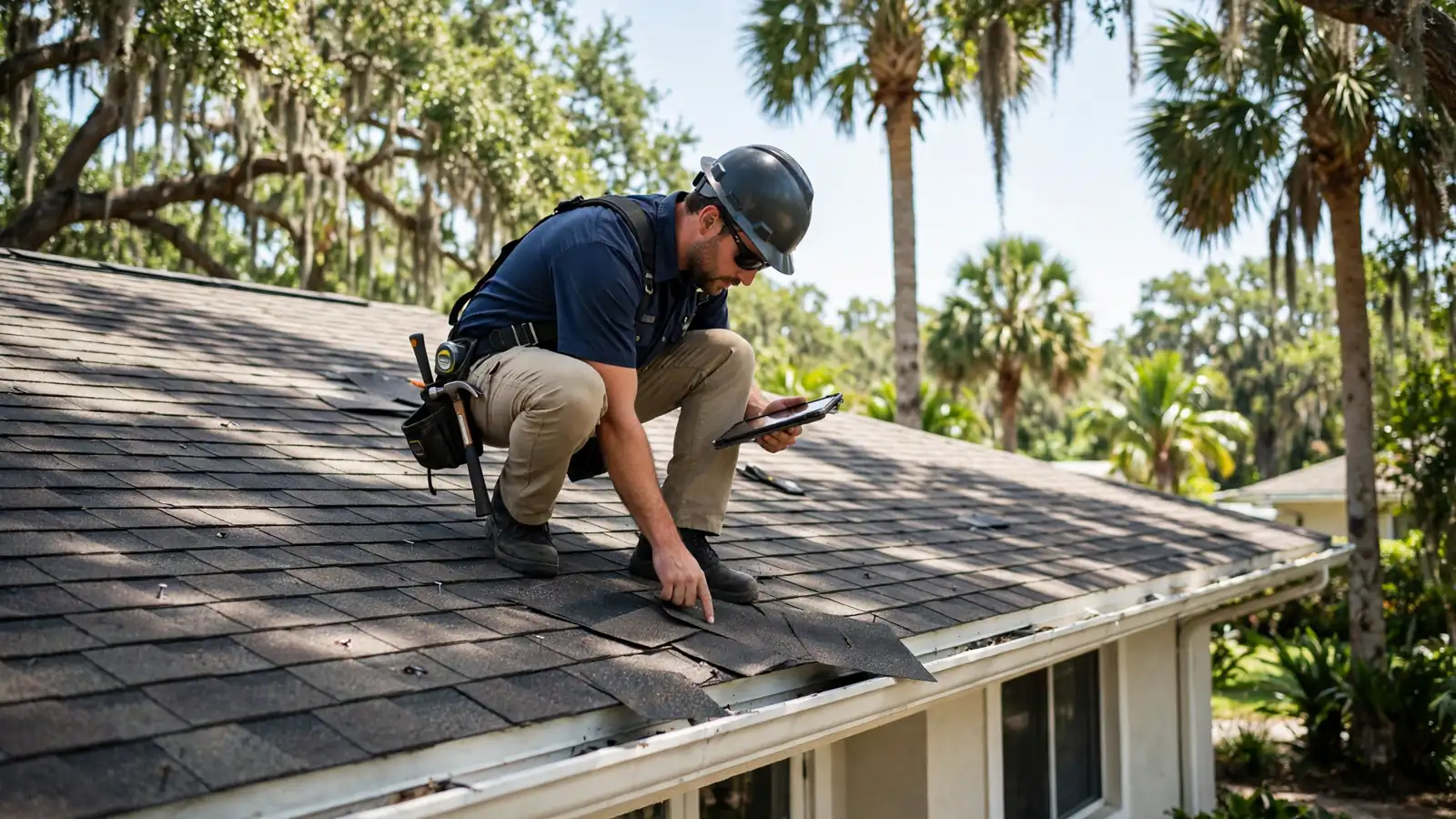
A roof inspection in Jacksonville, FL is a full survey of a Florida roof system, from shingle surface to attic deck. Driveway views miss lifted shingles, cracked flashing, and attic moisture. This page explains what inspectors check, what the survey costs, when to book one, and how the written report supports repair decisions and insurance claims. My Jacksonville Roofer is a connection service. The service connects Jacksonville homeowners with independent local roofers who inspect roofs across Duval County and Clay County. The inspection ends with dated photos, a defect map by slope, and a written report.
A roof inspection in Jacksonville, FL is a documented survey of every exterior and interior roof component on a home. The exterior survey examines shingles, tile or metal panels, flashing, vents, and gutters. The interior survey examines the attic, the roof decking, and moisture levels.
Exterior checkpoints include:
Interior checkpoints include:
The inspector marks each defect, photographs it, and records the location by roof slope. You keep the full photo set and a written summary. The summary lists each defect, its slope, and a severity rating.
The inspector records roof size in two units. A 2,000 square foot roof equals 20 roofing squares. One roofing square covers 100 square feet. Size drives every repair and replacement estimate that follows the survey.
The written report flags each defect and separates repair items from replacement items, and that split drives the roof repair in Jacksonville, FL decision. A verbal summary leaves nothing to show an insurer, a buyer, or a second bidder.
A Jacksonville roof inspection checks shingles, flashing, vents, gutters, attic ventilation, decking, and moisture in a fixed order. The inspector starts on the ground, moves to the roof surface, and finishes in the attic.
Florida roofs carry three material families. Architectural shingles cover most ranch homes in Mandarin, Southside, and Arlington. Tile covers Mediterranean-style homes in Ponte Vedra Beach and Saint Johns. Metal panels cover coastal homes and a growing share of replacements across Duval County. Each material fails in a distinct pattern, and the survey checks each pattern by name.
Shingle checks focus on wind lift. The inspector tests seal strips along eaves and rakes, counts missing tabs, and reads granule loss in gutters. Tile checks focus on cracked and slipped tiles plus the underlayment beneath them. Metal checks focus on fastener back-out, panel seams, and rust at cut edges.
Two inspection methods cover Jacksonville homes. Thorough surveys combine both methods:
| Method | What it checks | Best for | Typical cost |
|---|---|---|---|
| Walk-on inspection | Shingle condition, flashing, seals, and decking firmness by touch | Standard pitched roofs with safe access | $150 to $400 |
| Drone survey | Full-slope photo mapping of every field, ridge, and valley | Steep pitches, fragile tile, and large roof fields | $200 to $500 |
Either method takes 45 to 90 minutes on a standard home. The Florida Building Code sets wind-load and underlayment standards for roofs in Duval County, and the inspector notes code gaps on older housing stock during the survey.
Roof damage needs prompt attention because water often travels beyond the first visible stain.
A standard walk-on roof inspection in Jacksonville, FL costs $150 to $400, and a drone survey costs $200 to $500. Roof size, pitch, height, and access set the final figure inside the range.
A single-story ranch home in Orange Park sits at the low end. A two-story tile roof in Ponte Vedra Beach sits at the high end. Steep pitches add safety equipment time. Fragile tile adds drone time.
The price covers four deliverables: the full survey, dated photos of each defect, a defect map by slope, and a written remaining-life estimate. The report separates repair items from replacement triggers. That separation protects the homeowner during quote comparisons, since each bidder prices the same documented facts.
Inspection cost sits far below repair cost. Minor roof repair in Jacksonville costs $350 to $1,200. Larger repair costs $1,200 to $3,500. Full replacement costs $12,000 to $38,000 on a typical single-family home. A $150 to $400 survey steers each of those decisions.
Homeowners comparing survey cost against project cost use the roof replacement cost guide for Jacksonville, FL after the inspection report lands. The guide breaks replacement ranges down by material.
A Jacksonville home needs a roof inspection once a year, in spring before hurricane season, and after every major storm. Each timing serves a distinct purpose.
Hurricane season runs from June 1 to November 30. One spring visit covers the full season. Booking in March or April beats the June rush, since contractor schedules fill after the first named storm.
Age sets the second trigger. Roofs past 15 years develop quiet failures between storms: dried sealant, brittle boots, and slow flashing leaks. The annual visit catches each failure at patch size.
Florida insurers weigh roof age and condition at renewal. A current inspection report with dated photos answers insurer questions in one document. Keep the report with the policy papers.
Hurricane wind, river humidity, afternoon thunderstorms, and oak debris damage Jacksonville roofs through lift, moisture, impact, and trapped water. Each force attacks a different part of the roof system.
Wind attacks the edges first. Gusts crossing the St. Johns River and the Atlantic coast lift shingle tabs along eaves and rakes. A lifted tab breaks its seal strip. Broken seals let wind-driven rain under the shingle field during the next storm.
Humidity attacks from below and above. Jacksonville air stays humid for most of the year. Humid attic air condenses on cool decking at night. Surface humidity feeds black algae streaks on shaded north slopes, a pattern visible across Riverside, Avondale, and Springfield.
Afternoon thunderstorms attack through volume. Summer storms drop heavy rain in under one hour. Valleys carry the runoff load. Valleys clogged with oak leaves and acorns overflow, and overflow water backs up under shingles at the valley edge.
The oak canopy attacks through debris and shade. Mature oaks cover historic districts and older suburbs across Duval County. Leaves hold moisture against shingles. Branches scrape granules during storms. Shade slows drying after every rain.
Housing stock sets the exposure level. Ranch homes built from the 1950s through the 1980s dominate Mandarin, Arlington, and the Westside. Historic homes in Riverside, Avondale, and Springfield carry older roof structures under newer coverings. The inspection reads each stock type against the four forces and reports the combined wear.
A roof inspection supports a Florida insurance claim with dated photos, a defect map by slope, measurements, and a written damage timeline. Adjusters decide claims on documentation, not opinions.
Claim documentation includes:
The claim order runs in three steps: document the damage, stop active leaks with tarping, and file the claim. Emergency tarping counts as the duty to prevent further loss under standard Florida policies.
Clean documentation shortens adjuster review. Storm damage and age wear look similar after six months of sun and rain. The inspection date anchors the claim to the storm date. Photos taken within days of an event carry the most weight in the file.
Clay County homeowners start the same documentation process through roof repair in Orange Park, FL after storm damage. Keep two copies of the report: one for the claim file and one for home records.
The homeowner receives a written report with dated photos, a defect map, a remaining-life estimate, and repair or replacement guidance after a roof inspection in Jacksonville. The report sorts findings into three groups.
The remaining-life estimate sets the budget horizon. A roof with 5 years of life left justifies repair spending. A roof with under 2 years of life left makes replacement quotes the priority. Ask the inspector to explain the evidence behind the number.
Localized damage points to repair. Minor repair costs $350 to $1,200. Larger repair across several slopes costs $1,200 to $3,500. Widespread wear across the full field points to replacement at $12,000 to $38,000 on a typical home. The inspector explains both paths. The homeowner chooses the timeline.
Streets near Doctors Lake show the single-leak pattern clearly, and roof leak repair in Lakeside, Orange Park walks through the local version step by step. Two bids based on one report beat five guesses based on driveway views.
My Jacksonville Roofer connects a homeowner with a roof inspector in three steps: call, describe, and connect.
My Jacksonville Roofer is a connection service. The service is not a roofing company. The service employs no inspectors and no roofing crews. Independent local roofers perform inspections and complete roof work.
A roofing specialist answers and records the address, roof material, and concern.
Explain the stain, the storm, the home purchase, or the insurer request. The specialist matches the concern to the right survey type.
An independent roofer serving your city schedules the visit and delivers the written report.
The full service list sits on the Jacksonville roofing connection service homepage. A roof inspection in Jacksonville, FL is a full survey of a Florida roof system, from shingle surface to attic deck. The inspection ends with dated photos, a defect map by slope, and a written report. That document steers the repair decision, the replacement budget, and the insurance claim.
Neighbourhood-level inspections pages sit under their city pages, so homeowners find a page written for their own streets.
A standard roof inspection takes 45 to 90 minutes on a typical Jacksonville home. The survey covers the roof surface and the attic. Large, steep, and multi-story roofs take up to 2 hours. The visit ends with a findings review on the spot. The written report with dated photos follows within 24 hours in most cases.
A walk-on roof inspection in Jacksonville, FL costs $150 to $400. A drone survey costs $200 to $500. Roof size, pitch, height, and access set the final price. The price covers the survey, dated photos, a defect map by slope, and a written remaining-life estimate. The inspector confirms the fee before the visit.
A roof inspection in Jacksonville, FL includes an exterior survey of shingles, tile or metal panels, flashing, vents, and gutters, plus an interior survey of attic ventilation, decking, and moisture. The inspection ends with dated photos, a defect map by slope, and a written report. Most inspections take 45 to 90 minutes.
A Jacksonville home needs a roof inspection once a year and after every major storm. Spring is the standard annual slot. The spring visit catches winter wear before hurricane season opens on June 1. Post-storm visits document fresh wind damage while marks stay visible. Homes past 15 years gain the most from the yearly visit.
Yes. A roof inspection gives the claim file dated photos, slope-by-slope damage mapping, and a written timeline. Adjusters separate covered storm damage from uncovered wear with that documentation. Photos taken within days of a storm carry the most weight. The homeowner files the claim. The inspection report supports the filing.
A walk-on inspection finds soft decking, lifted shingles, and failed seals by touch. A drone survey maps steep pitches, fragile tile, and large roof fields from the air. Thorough surveys combine both methods. The drone maps the full field first. The walk-on visit verifies each flagged point. The inspector states the method before booking.